Physical AI · Spatiotemporal Intelligence Automation Plane
The memory of truth for Physical AI.
Meerv provides the sustainable identity which QDat.io memorizes to hold physical AI accountable to the what, when and where of every thing.
Spatial Capture
QDatDroid is how spatial reality gets recorded systematically everywhere.
Handheld RFID readers running QDatDroid turn every field scan into a spatiotemporal event. The device reads radiofrequency identity, inherits GPS coordinates, timestamps the event, and pushes it over public or private 5G mobile networks into QDat.io.
That matters because space is usually the missing field in operational data. QDatDroid closes that gap by making mobile RFID, connectivity, and location capture part of one workflow for operators in motion.
QDatDroid can also download predictive shelf-life models, run them against Cooldat® data at the edge, and support autonomous decision making in complex environments such as cold storage where timing, mobility, and local execution matter.
Runs on Android phones, tablets, and Zebra handheld RFID readers.
Uses public and private 5G connectivity to stream scans from the field.
Captures GPS coordinates automatically so location becomes part of the record.
Downloads predictive shelf-life models and applies them against Cooldat® data in the field.
Handheld Edge Layer
RFID scan, 5G sync, GPS inheritance, one operational loop.
Handheld readers
Operators carry QDatDroid on RFID-capable Android devices where work actually happens.
5G networks
Events sync through public or private mobile networks instead of waiting for fixed infrastructure.
GPS coordinates
The app inherits device location so spatial context is captured systematically, not manually.
Edge decisions
Predictive shelf-life models can run against Cooldat® data on the device to guide action in cold storage and other complex environments.
See Cooldat®Every Thing connected to
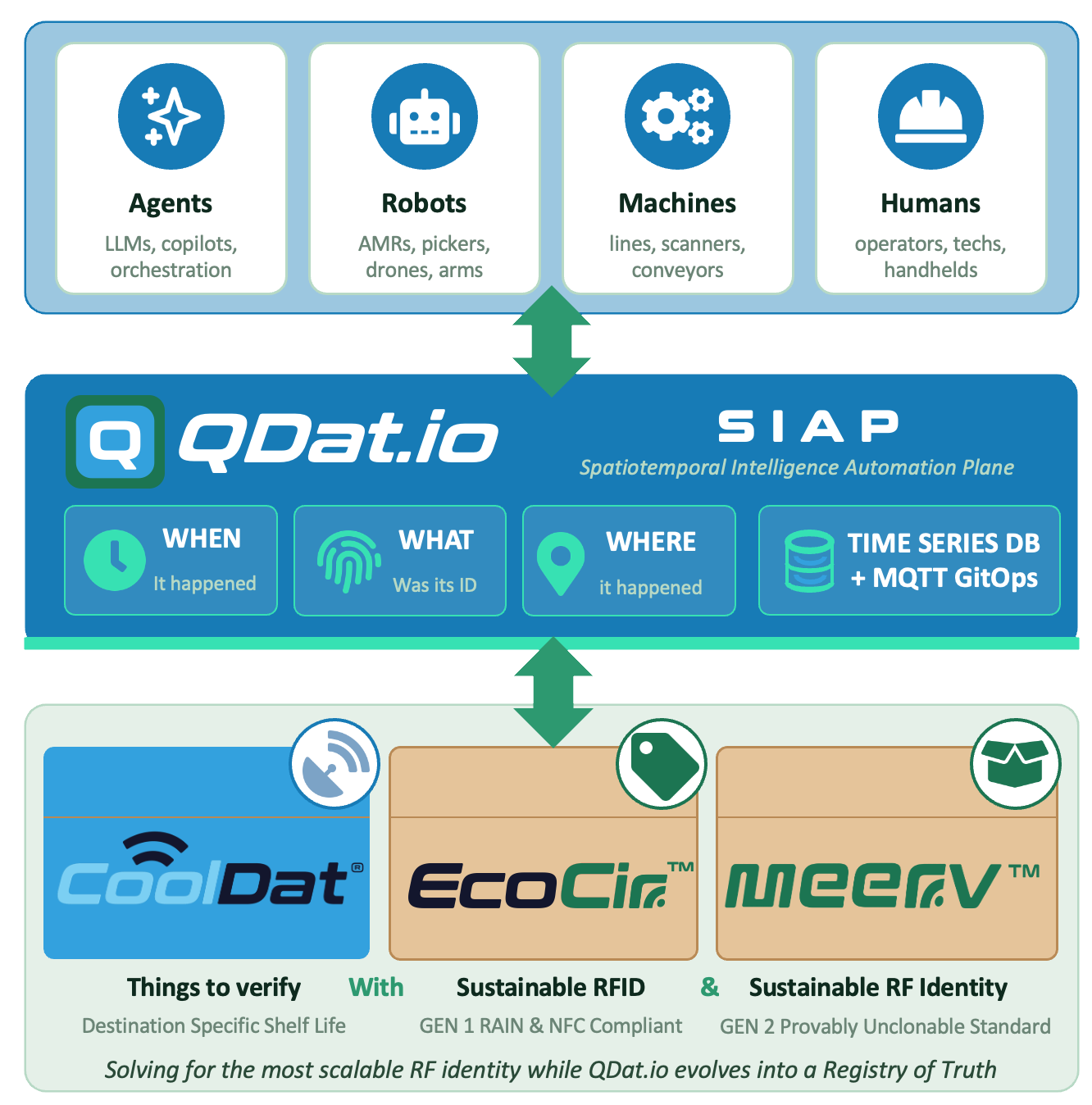
Agents, Robots, Machines, and Humans on one plane
The plane has no preferred actor. Whatever is acting on a Thing — software or steel, autonomous or operator-driven — talks to the Thing through the same spatiotemporal interface, exposed equivalently as a RESTful API for systems and as an MCP server for agents.
Agents
LLM agents, copilots, and orchestration logic query the plane over REST and MCP for the live state of each Thing — identity, location, history, current alarms — and write decisions back.
Robots
AMRs, pickers, drones, and arms subscribe to spatiotemporal events on the plane to know what Thing they are facing, where it has been, and whether it is in spec before they grasp, move, or sort it.
Machines
Production lines, scanners, printers, conveyors, and refrigeration equipment publish state changes and consume per-Thing context. The plane closes the loop between automation hardware and the items it processes.
Humans
Operators, drivers, technicians, and inspectors meet the plane through handheld and mobile reader clients (QDatDroid) and dashboards. They see the same Thing-level history the agents and robots see.
How It Works
Identity becomes intelligence in four moves.
Every QDat.io deployment follows the same four moves: sustainable RF identity makes each Thing legible to the plane, reads capture its real-world Where and When, the record is reconciled against ERP and operational systems, and the resulting deltas trigger action in time — every loop training the next decision.
01
Assign identity
Give each asset a radiofrequency identity that can be sensed without relying on fragile manual updates.
02
Query reality
Capture where the asset is, when it moved, and how long it dwelled there.
03
Reconcile systems
Compare ground truth against ERP and operational software to detect drift, lag, and false validity.
04
Trigger and train
Launch actions in time, then loop the results back into the AI and automation stack.
QDat.io
Truth worth remembering.
Contact
Learn more about Physical AI on Every Thing
QDat.io is the memory of truth for Physical AI — sustainable RF identity, a spatiotemporal data plane, and agent-ready REST and MCP surfaces that let agents reason and act on every Thing you operate. Tell us about your asset flows, system stack, and where decisions need to land, and we'll show how per-Thing truth can be built into your operations at scale.
Pick a time that works for you and talk directly with our team about your asset flows, system stack, and where decisions need to land.